

Can I Recycle Wrapping Paper?

I want to begin by stating that you can and should REUSE wrapping paper for as long as possible. If you (and others in your family and friend group) are careful about how you open gifts, you can usually get it off in a single sheet with minimal tears that you can reuse - sometimes for years. It makes quite a fun game, actually (consider awarding prizes annually and scrawling the original year on the backside of the paper to help you keep track of how long a given piece has been in circulation.) There are also other ways to cut down on how much used wrapping paper you end up with such as using fabric or reusing a paper bag to wrap your gifts. But eventually, even a well-preserved sheet of wrapping paper will reach the end of its useful life. When that happens, it may seem like an obvious candidate for recycling — it’s paper! — but that can be deceptive. In fact, many types of wrapping paper are not recyclable and the reason, unsurprisingly, comes down to plastic.
Wrapping paper can contain a coating of thin plastic to give it shine and strength. Additionally, there are often decorative elements like metallic foil, plastic-based ink, and glitter, which are intentionally-made microplastics. These contaminants interfere with the recycling process.
To understand why, it helps to understand the science of paper recycling. Paper is made of cellulose, long-chain polymers found in plant cell walls and usually obtained from wood. When paper is recycled, it’s mixed with water and mechanically agitated until each cellulose fiber is separated and suspended in the water — a slurry called pulp. The water is then removed, allowing the fibers to form new bonds with one another and dry into a dense, tangled network — this matrix becomes a new sheet of paper.
During the pulping process, plastic coatings and decorative elements don’t dissolve in water. Instead, they can remain attached to fibers or break into small flakes that contaminate the pulp, making it harder to separate fibers cleanly. This contamination can lower the quality of recycled paper and increase processing costs. While some recycling facilities have developed systems to successfully remove some plastic, wrapping paper is particularly tricky because coatings, foils, glitter, and inks vary widely from brand to brand.
Simpler wrapping paper — especially uncoated, matte paper — can be recycled, but it’s easy to get it wrong. To be safe, consider alternatives this holiday season: newspaper, fabric wraps, or reusable bags all avoid the challenges posed by plastic coatings, foils, and glitter.
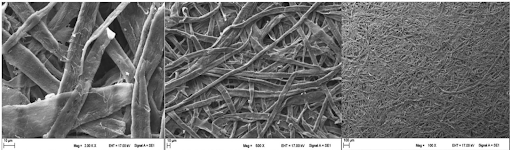
Image: Recycled paper under a scanning electron microscope seen at 2000x, 500x, and 100x magnification.
Source: Yilmaz, Tutuş, and Sönmez 2022, Journal of Adhesion Science and Technology
Do you have a question about the science of plastics? You can submit it here for Trisha’s consideration. Please note that we cannot answer every question we receive.
