
How Does Plastic Affect Our Hormones?
Plastic pollution isn’t just an environmental problem, it’s also a human health issue. One of the most well-studied concerns involves chemicals that disrupt the body’s hormone system, known as the endocrine system. Many of these endocrine-disrupting chemicals (EDCs) — including phthalates, bisphenols, flame retardants, and PFAS — are found in plastics. But how do they actually affect our bodies?
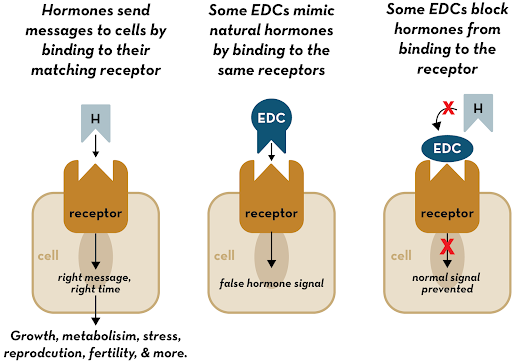
Our body relies on hormones, which act as chemical messages, travelling through the bloodstream to tell cells what to do. Hormones work through a lock-and-key system: each hormone has a specific shape (the key) that binds to a matching receptor (the lock) on or inside a cell. When the right hormone binds to the right receptor, it triggers a response, guiding processes like growth, metabolism, reproduction, brain development, sleep, and stress. This system depends on precision: tiny amounts of hormones released at exactly the right time.
The endocrine system — which includes glands like the thyroid, pancreas, and adrenal glands — coordinates this messaging, while EDCs interfere in several ways. Some EDCs mimic natural hormones, tricking receptors into sending signals when they shouldn’t. Others block receptors, preventing real hormones from binding. Some EDCs also change how much hormone the body makes or how quickly hormones are broken down.
Because hormone signaling is so finely tuned, even small disruptions can have serious effects. EDC exposure has been linked to many health harms, including cancers, metabolic disease, infertility, neurodevelopmental and autoimmune disorders, and reproductive health problems. Timing also matters: very low exposures during pregnancy, childhood, or puberty can have outsized impacts.
Studies suggest nearly everyone has measurable levels of EDCs in their bodies. While reducing our own plastic use can help, the most effective solution is strong policies that limit harmful chemicals and promote safer alternatives. Unfortunately, the EPA recently announced it will not regulate the group of EDCs called phthalates in consumer products. Click here to learn more about this disappointing decision.
Do you have a question about the science of plastics? You can submit it here for Trisha’s consideration. Please note that we cannot answer every question we receive.
