REPORT: Tracking Starbucks’ Deceptive Recyclability Claims
MAY 2026 | BEYOND PLASTICS
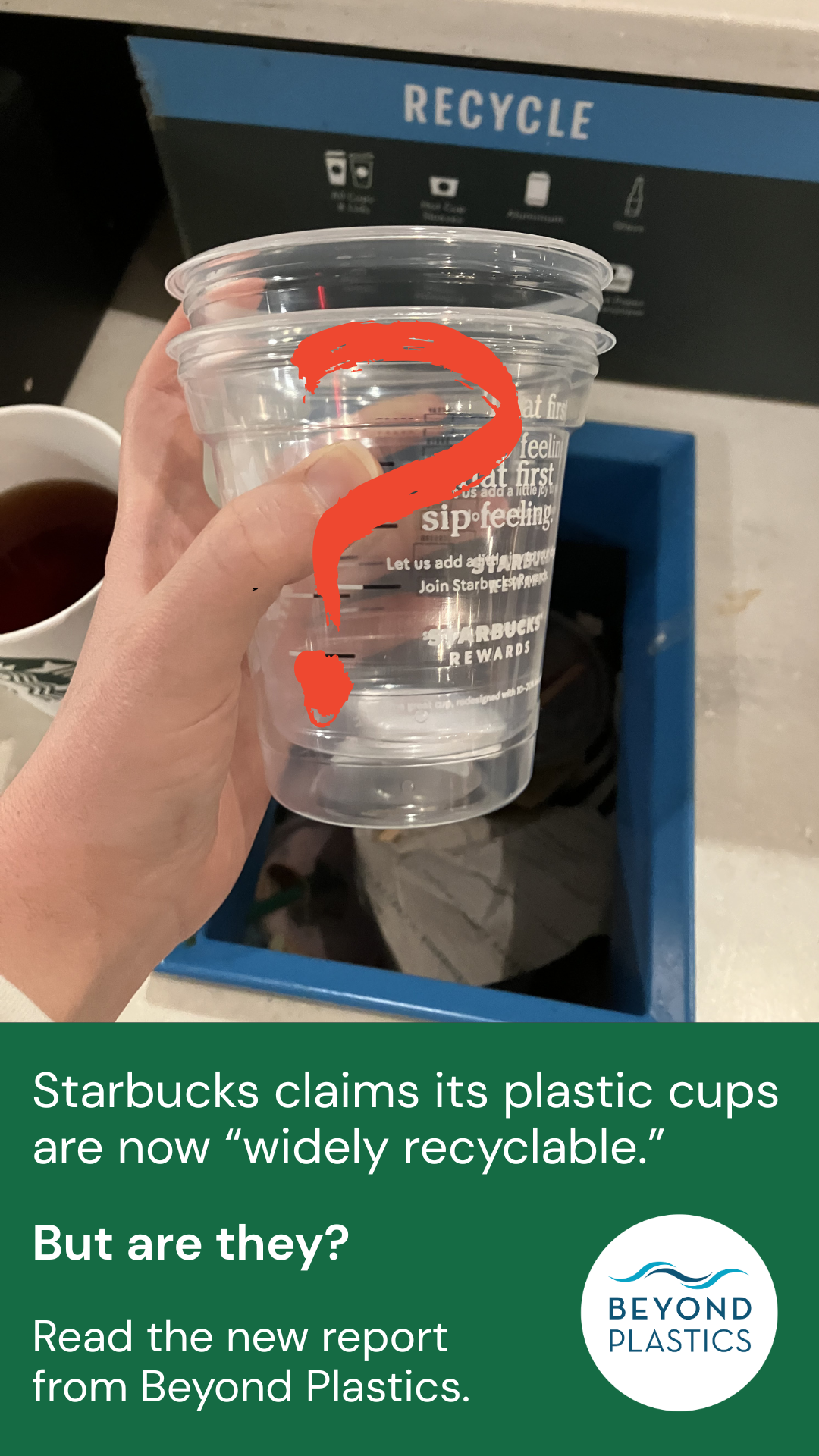
A three-month national investigation by Beyond Plastics found that not a single tracked Starbucks cold-beverage cup ended up at a recycling facility — even when the cups were placed in clearly marked recycling bins inside Starbucks stores. As detailed in the new report, titled “Tracking Starbucks’ Deceptive Recyclability Claims,” the findings directly contradict Starbucks’ recent public claims that its single-use polypropylene (No. 5 plastic) cold cups are “widely recyclable.”
"Starbucks is telling its customers that these plastic cups get recycled, but our trackers tell a different story — they're ending up in landfills and incinerators and not being recycled," said Judith Enck, president of Beyond Plastics and a former EPA regional administrator. "Accepting a plastic item for recycling is not the same as actually recycling it, and the company knows the difference. It's time for Starbucks to stop making misleading recycling claims and start prioritizing plastic-free, preferably reusable, alternatives for its customers."
Between January and March 2026, Beyond Plastics placed 53 Bluetooth-enabled trackers inside single-use polypropylene cold cups and dropped them into in-store recycling bins at 35 Starbucks locations across nine states and Washington, D.C. Of the 36 trackers that returned usable data, none pinged from a recycling facility. Instead, the cups traveled to landfills, incinerators, waste-transfer stations, and material recovery facilities.
Key Findings:
Of the 36 trackers that successfully moved from the store and reached a final destination:
0 pinged from an actual recycling facility
16 ended up in landfills
9 ended up at incinerator facilities
8 were last detected at waste-transfer stations — a stop on the way to a landfill or incinerator
3 reached materials recovery facilities (MRFs), which sort and bale plastic but do not themselves recycle it — a stop at an MRF does not mean a cup was recycled
The tracked cups collectively traveled thousands of miles. Four cups crossed state lines from New York City to a landfill in Amsterdam, Ohio — the longest single trip was 463 miles, beginning at a Starbucks at 225 4th Avenue in Brooklyn to the Ohio landfill.
A Second Finding: Many Starbucks Stores Offered No Recycling at All
Beyond Plastics initially focused on 21 states for the investigation but was able to deploy trackers in only 10 of them. The stores surveyed in the other 11 states did not offer recycling at all or had specific signage showing that Starbucks’ plastic and paper cups are collected for landfill only. This is notable given that Starbucks is publicly promoting its polypropylene cold cups as “widely recyclable” nationwide.
Why This Matters
On February 2, 2026, Starbucks announced — alongside WM (formerly Waste Management) and three recycling groups — that polypropylene was now considered “widely recyclable” in the United States, a designation issued by the labeling program How2Recycle that is not vetted by state or federal regulators. Starbucks said the change meant more than 60% of U.S. households could recycle its cold cups curbside.
But access to a recycling program is not the same as a cup actually being recycled. The U.S. recycling rate for plastics is under 6%, and most of that is No. 1 (PET) and No. 2 (HDPE) bottles and jugs — not polypropylene.
What’s more, polypropylene has very few places to go for recycling in the United States. The exact number of polypropylene recycling facilities nationwide is difficult to determine without publicly available and up-to-date databases. A December 2025 Greenpeace report identified two commercially operating facilities in the entire country that claim to recycle post-consumer polypropylene: KW Plastics in Troy, Alabama, and St. Joseph Plastics in Saint Joseph, Missouri. An Ultra-Poly recycling facility in Portland, Pennsylvania, claims to recycle polypropylene, and Republic Services Blue Polymers facilities in Indianapolis and Las Vegas claim to recycle post-consumer polypropylene plastic.
PureCycle's Ironton, Ohio, plant claims to recycle polypropylene through so-called "chemical recycling,” but Beyond Plastics does not consider chemical recycling to be recycling given that most of the plastic these facilities accept is not actually recycled but turned into fossil fuels or feedstocks using high heat or chemicals. It's a distraction that has failed for decades and is allowing companies to exponentially increase plastic production while polluting low-income communities and communities of color with hazardous waste and toxic air pollution.
Given the low value of used polypropylene, the cost of shipping it long distances, and high contamination from liquids and food residue, it is unlikely that cups collected nationwide are reaching recycling plants. In California, polypropylene bales have an average contamination rate of 31% — far above the 2% that KW Plastics accepts.
Starbucks is the world’s largest coffee chain, with more than 40,000 stores worldwide. About 75% of its U.S. beverage sales are cold drinks, most often served in polypropylene cups. In 2020, Starbucks committed to making 100% of its customer packaging reusable, recyclable, or compostable by 2030; nearly all of its 17,000-plus U.S. stores still use plastic cups and packaging.
View the data, including a map visualization of the cups’ journeys from recycling bin to final destination.
TAKE ACTION
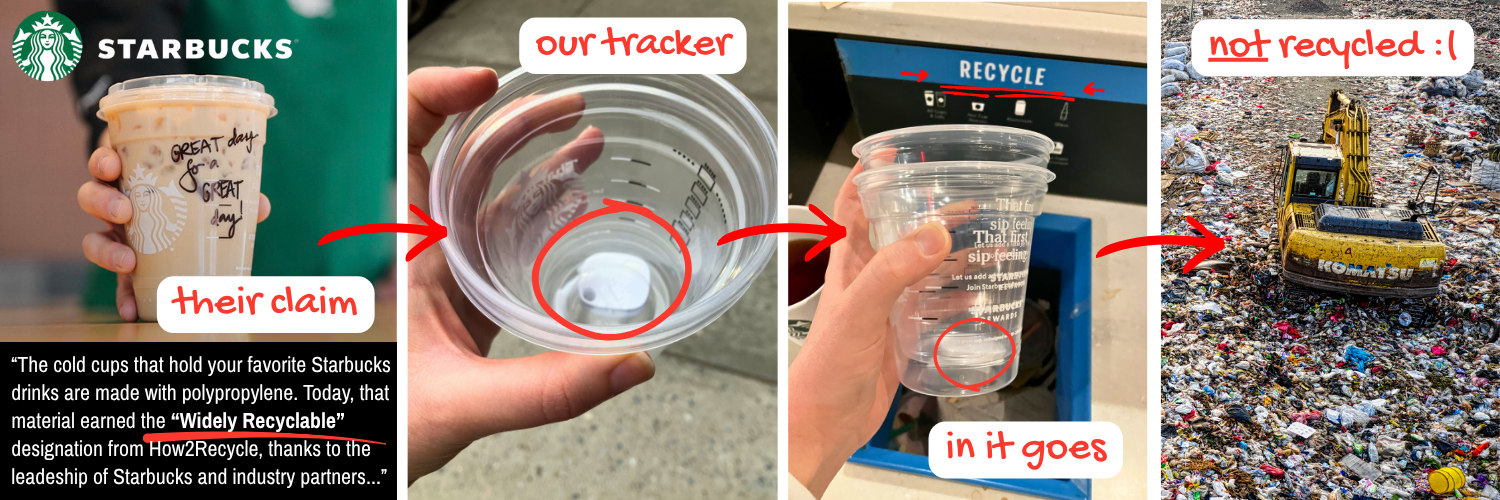
Urge Starbucks to stop attempting to deceive the public and its customers about the recyclability of its single-use plastic cold cups and focus on advancing effective ways to reduce the amount of plastic waste they’re producing. Fill out the fields below to add your name to the petition.
If you have any trouble signing the petition, click here to visit it.
To: Starbucks CEO, Brian Niccol cc: California Attorney General Rob Bonta
Starbucks proudly claims that its single-use plastic cups are "widely recyclable" via a new partnership with WM (formerly known as Waste Management). However, a new nationwide cup-tracking investigation by Beyond Plastics found this claim to be deceptive. Not one of the discarded cups tracked in the three-month investigation ended up at a recycling facility.
Instead, 16 cups ended up in landfills, nine ended up at incinerator facilities, and nine were last detected at waste-transfer stations, a stop on the way to a landfill. Zero cups ended up at a recycling facility.
Rather than continuing to pour money into public-relations efforts to deceive consumers about the recyclability of its plastic cold cups, we urge Starbucks to make the following three changes to actually reduce the amount of single-use plastic waste it adds to the environment each day.
We call on Starbucks to:
1. Immediately stop deceiving the public about plastics recycling at Starbucks stores by removing the recycling images of plastic cups from in-store recycling bins.
2. Train employees to follow Starbucks' “A Better Cup for All” policy by serving ALL customers who order inside their company-owned stores in a reusable ceramic mug or glass cup, unless the customer specifically requests a to-go cup. Although Starbucks says this is their policy, the reusable containers are often not offered.
3. Implement a nationwide switch from plastic to fiber-based to-go cups and lids, just as the company has already done in more than 550 stores across 14 states.

SHARE THE REPORT
We’ve put together a simple sharing toolkit to make it easy to spread the word about the report. The toolkit includes graphics, sample text for sharing it on social media, and a sample outreach email.

NEWS RELEASE
Beyond Plastics Tracked Starbucks’ ‘Widely Recyclable’ Plastic Cups. None Ended Up at a Recycling Facility.
Electronic Bluetooth Trackers Placed in Starbucks’ In-Store Recycling Bins Followed the Polypropylene Cups to Landfills and Incinerators

QUESTIONS OR IDEAS?
We welcome your feedback, questions, and ideas. You can email us at beyondplastics@bennington.edu.
NEWS COVERAGE
Reuters | US group says Starbucks plastic cups marked recyclable end up in trash | May 20, 2026
The Guardian | Starbucks does not recycle plastic cups it claims are ‘widely recyclable’, report says | May 20, 2026
The Washington Post | Group tracking Starbucks cold cups says none made it to recycling facility | May 20, 2026
Plastics News | Beyond Plastics challenges Starbucks PP recycling claims | May 20, 2026
