

Are microplastics helping to create drug-resistant superbugs?

Antibiotic drugs are part of modern medicine, used to treat infections that were once deadly, from pneumonia to infected wounds. But over time, bacteria can evolve to resist antibiotics. Scientists are increasingly alarmed by the rise of antibiotic-resistant bacteria, or “superbugs,” which could make even minor infections much harder to treat. In fact, antibiotic resistance is considered a top 10 threat to global health by the World Health Organization and is estimated to account for 5 million deaths per year across the world. Plastic may seem unrelated, but recent discoveries are finding a surprising link — for example, a 2025 study found that exposing E. coli bacteria to microplastics for 10 days caused the bacteria to develop a 100 times greater resistance to common antibiotics.
How could plastic enhance antibiotic-resistance superbugs? Microplastic particles — any plastic piece smaller than 5 millimeters — do not exist in the environment as pure plastic. Instead, the surface is colonized by many microorganisms that get picked up along the way, creating a mini-ecosystem called the “plastisphere.” In this type of ecosystem, bacteria can link up to create a protective layer called biofilm, which appears to let in just enough antibiotics to help them build up a defense. In fact, something about plastic seems to promote this, with researchers finding bacteria can form thicker biofilms on plastic beads than on glass beads.
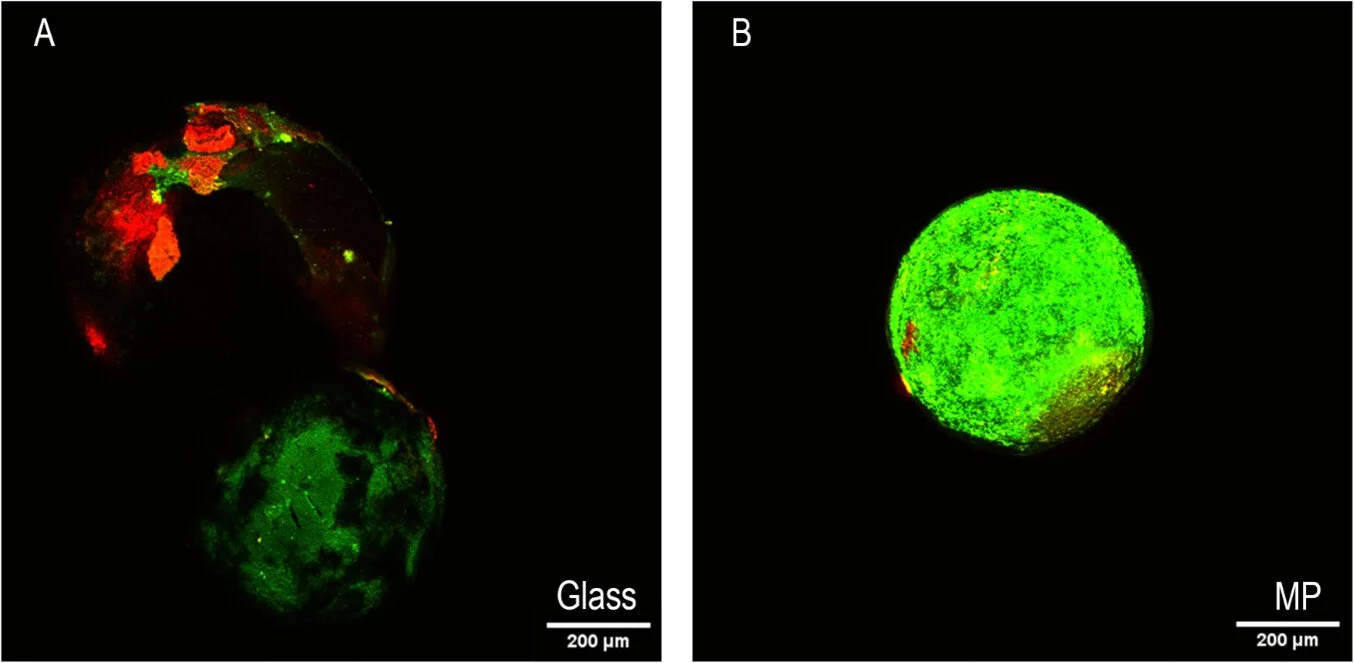
Microplastics may promote the creation of bacterial biofilms, which can help create drug-resistant bacteria. Here is a microscope image showing a much thicker and healthier biofilm on the microplastic bead (right) compared to the glass bead (left), with green indicating living cells and red indicating dead cells.
Image obtained from Gross et al., 2025, Journal of Bacteriology.
Microplastics also act as a hotspot for bacteria to gather and interact. In these crowded environments, if one bacterium develops the ability to defend itself against antibiotics, it can easily share those genes with the entire community through a process known as horizontal gene transfer. In fact, microplastics can increase the transfer of antibiotic resistant genes by 200 times!
Microplastics carrying antibiotic-resistant bacteria can enter our water, soil, and food, potentially exposing humans to these drug-resistant superbugs. Scientists are working to better understand this, and have found that superbugs may also be created during the production and use of plastic. There is also ongoing research to understand what plastic characteristics — such as the polymer type or chemical additives used — are most responsible for promoting antibiotic resistance.
While this research is ongoing, the link between plastics and superbugs is a reminder that plastic pollution and human health are deeply connected. Strong policies that reduce plastic and the buildup of microplastics in the environment are key to protecting your health.
To learn more about this, check out this excellent article in Mongabay about microplastics and antibiotic resistance.
Do you have a question about the science of plastics? You can submit it here for Trisha’s consideration. Please note that we cannot answer every question we receive.
