

Does plastic pollution make climate change worse?

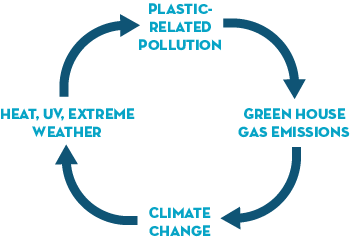
Plastic pollution is often treated as a waste problem, separate from climate change. In reality, the two crises are deeply interconnected. Plastic pollution contributes to climate change, and climate change, in turn, makes plastic pollution harder to control.
Plastic Pollution Contributes to Climate Change.
Plastic is made from fossil fuels — often ethane derived from fracked natural gas —and releases greenhouse gases at every stage of its life cycle, from production to disposal (to learn more about this, check out our report here). In fact, primary plastic production released nearly four times as many greenhouse gases as the entire global aviation industry. As plastic production continues to rise, plastic becomes an increasingly significant contributor to climate change.
Microplastics — tiny pieces of plastic formed as plastic breaks up in the environment — can also exacerbate climate impacts. For example, microplastics in soil interfere with normal carbon cycling and increase greenhouse gas emissions. A recent study from May 2026 also found that microplastics in the atmosphere may increase global temperatures through heat absorption.
Climate Change Contributes to Plastic Pollution.
The reverse relationship is less widely recognized, but growing evidence suggests that plastic pollution is amplified by a warming planet.
First, increased temperatures, UV radiation, and humidity all work to increase the rate at which plastic fragments in the environment, accelerating the production of microplastics. Increased temperatures also increase the release of chemicals from plastic into the environment — just like how heating plastic in a microwave can increase the health risk for us.
Second, climate-driven weather events — such as floods, hurricanes, and wildfires — can transport plastic over long distances, spreading it throughout the environment and even to remote regions like Mount Everest. Rising temperatures, wind, and increased rainfall can also move plastics from semi-contained places, like landfills, to waterways and oceans.
When Plastic Pollution and Climate Change Combine.
In some cases, plastic pollution and climate change reinforce one another. Microplastics in soil will interact with heat and carbon dioxide to further disrupt crop production. For some fish, warmer waters increase the ingestion of microplastics and intensify the toxicity of the plastic. When zooplankton eat microplastics, it can accelerate loss of oxygen in the ocean. Another study found that mussels experience more health problems when exposed to microplastics in low-oxygen and acidic seawater than in typical seawater.
Taken together, this research highlights an important reality: Plastic pollution and climate change are not separate environmental challenges. They are linked crises that intensify one another. Reducing our dependence on plastic is not only critical for addressing pollution and our health, but also an important part of fighting climate change.
Do you have a question about the science of plastics? You can submit it here for Trisha’s consideration. Please note that we cannot answer every question we receive.
