

Reckoning With the U.S. Role In Global Ocean Plastic
Reckoning with the U.S. Role in Global Ocean Plastic Waste calls for a national strategy by the end of 2022 to reduce the nation's contribution to global ocean plastic waste at every step - from production to its entry into the environment - including by substantially reducing U.S. solid waste generation.
Plastics and Microplastics: A Threat to the Environment and Health
EHHI reviewed nearly 500 scientific studies for this report and found that each of us ingests and inhales millions of microscopic plastic particles each year. Microplastics carry chemical additives and coatings as well as potentially pathogenic microbes. Disturbingly, their impact on human health is not yet known.
Plastic’s Toxic Chemical Problem: A Growing Public Health Crisis
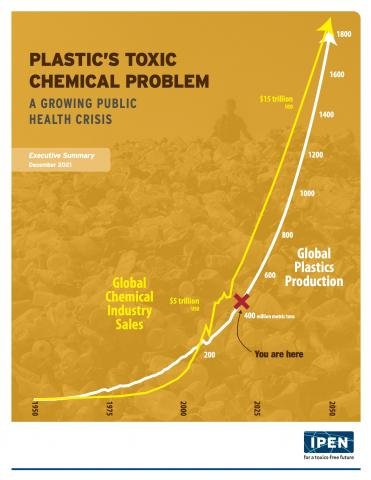
IPEN and IPW studies show that throughout their life cycle, plastics transport and release toxic chemicals globally, posing serious threats to human health and ecosystems.

A Rapid Review and Meta-regression Analyses of the Toxicological Impacts of Microplastic Exposure in Human Cells
The prevalence of microplastics (MPs) is ubiquitous, found in almost every compartment of the environment; in the air (Wright et al., 2020), food (Teng et al., 2019) and drinking water (Zhang et al., 2020). MP contamination will continue to rise as plastic production and use around the world increases (Lebreton and Andrady, 2019). If plastic waste mismanagement continues as it is or increases, it is predicted that within a century, MP ecological risks will be widespread in ecosystems across the world (SAM, 2019; SAPEA, 2019).

The New Coal: Plastics & Climate Change
Beyond Plastics’ new report reveals that the U.S. plastics industry is a major driver of our climate crisis. Using coal-fired power plants as a benchmark, the report examines ten stages in the creation, usage, and disposal of plastics.
Plastic is Carbon: unwrapping the “net zero” myth
Under the cover of “net zero,” the plastics and petrochemical industry is trying to greenwash expanded plastic production and use. “Net zero” plans purport to make continued use of fossil fuels “emission-free,” but scientists, Indigenous peoples, and civil society organizations oppose this diversion that creates risks for communities and the environment.

Path of Toxic Pollution
How making “forever chemicals” for food packaging threatens people and the climate.

The Global Threat From Plastic Pollution
The rational response to the global threat posed by accumulating and poorly reversible plastic pollution is to rapidly reduce plastic emissions through reductions in consumption of virgin plastic materials, along with internationally coordinated strategies for waste management.

Plastic Waste Management Hazards: Waste-To-Energy, Chemical recycling, and plastic Fuels
With petrochemical companies avoiding fossil fuel carbon liabilities by massively increasing plastic production, the amount of plastic waste generated is set to climb dramatically. This report examines the current and emerging methods by which plastic waste is managed globally and questions whether any of them present a solution to the rapidly accelerating generation of plastic waste.

Plastic Waste Poisoning People in Africa, Asia, Central and Eastern Europe & Latin America
Plastics and food packaging contain chemical contaminants from manufacturing along with many additives to make them inflammable, more flexible, grease-resistant, or sterile, as well as other substances to create many other properties. Many of these additives are toxic and they leak from products during use and can be released during recycling and from recycled products.
This study focuses on persistent organic pollutants (POPs), whose releases are closely related to plastic wastes. The POPs include additives in the plastic as such, as well as unintentionally produced POPs (UPOPs) generated mostly by burning, incineration and/or other thermal treatment of plastics.
Four samples from this study are among the ten highest ever measured levels of chlorinated dioxins in chicken eggs globally.

Deep Dive into Plastic Monomers, Additives, and Processing Aids
A new study finds that plastics release many more toxic chemicals throughout their life cycle than previously thought, posing significant risks to both people and the planet.

Missing the Mark: Unveiling corporate false solutions to the plastic pollution crisis
For the first time, Break Free From Plastic has recorded the plastic solutions projects of our seven top plastic polluters, and classified the projects according to whether they are real solutions or false ones.

Reuse wins: top findings show reuse beats single-use every time
Reuse Wins shows how a new reuse economy is emerging to replace the use of single-use products in food service.
Presence of airborne microplastics in human lung tissue
Microplastics are present in the air and may be inhaled by humans, but whether they have deleterious effects on the respiratory system remain unknown. In this study, we determined the presence of microplastics in human lung tissues obtained at autopsies.
High frequency of micro- and meso-plastics ingestion in a sample of neonate sea turtles from a major rookery
Evidence points to plastics ingestion being an important source of population-level effects in neonate sea turtles.
Chemical Impact: Microplastic pollution more complex than we think, says new research
Microplastic pollution has been building up in the Great Lakes for at least four decades, but our understanding of its impact on fish and other aquatic creatures is only just catching up.

Aquatic Pollutants In Oceans And Fisheries
Pollutants including industrial chemicals, pesticides, pharmaceuticals, heavy metals, plastics and microplastics have deleterious impacts to aquatic ecosystems at all trophic levels from plankton to whales.

Constraining the atmospheric limb of the plastic cycle
In modeling the atmospheric limb of the plastic cycle, we show that most atmospheric plastics are derived from the legacy production of plastics from waste that has continued to build up in the environment.
Waste and Opportunity 2020: Searching for Corporate Leadership
This study measures the progress of 50 large companies in the beverage, quick-service restaurant, consumer packaged goods, and retail sectors on six core pillars where swift action is needed to reduce plastic pollution,

Microplastics Found in 100 Percent of Tested Pennsylvania waterways
At 53 waterways tested across Pennsylvania, microplastic contamination was found in every spot, from Lake Erie, Pittsburgh's Three Rivers and the Delaware River, according to a new report entitled Microplastics in Pennsylvania: a Survey of Waterways released Wednesday.