Demonstrations at 22 Starbucks Stores Across 11 States Call on Coffee Giant to Stop Lying About Plastics Recycling
Beyond Plastics investigations found no Starbucks cold cups recycled, despite company’s policies
For Immediate Release: September 28, 2026
Contacts:
Dina Cappiello — dina@lifecyclecommunications.com, 202-415-5642
Judith Enck, Beyond Plastics — judithenck@bennington.edu, (518) 605-1770
Bennington, VT — Demonstrators at 22 Starbucks stores across 11 states are calling on the coffee giant to stop telling customers that its single-use plastic cold cups are “widely recyclable,” after a nationwide tracking investigation by Beyond Plastics could not confirm a single cup being recycled.
The demonstrations in Massachusetts, New York, Arizona, Pennsylvania, New Hampshire, Vermont, California, Illinois, Colorado, Washington and Texas are part of a Starbucks Week of Action urging the company to stop making deceptive recycling claims that give customers the false impression that plastic cold cups deposited in their store recycling bins are recycled.
“Customers who carefully put their Starbucks cup into a recycling bin with an image of a plastic cold cup on it reasonably expect it to be recycled,” said Judith Enck, president of Beyond Plastics and a former EPA regional administrator, who plans to join the demonstration at an Albany, NY, store Saturday. “Our investigation found something very different. Not one of the cups we successfully tracked was confirmed recycled. Starbucks needs to stop misleading customers about plastic recycling and focus instead on reducing single-use plastic and expanding reusable and plastic-free alternatives.”
Beyond Plastics, its partners, and demonstrators nationwide are calling on Starbucks to:
Stop portraying its single-use plastic cold cups as “widely recyclable” when the company cannot demonstrate that the cups are actually being recycled at scale.
Remove images and messaging that may lead customers to believe Starbucks plastic cups placed in store recycling bins will be recycled.
Honor existing Starbucks policy of providing reusable cups for beverages consumed inside the store.
Replace plastic cups for their cold drinks with fiber-based cups.
In addition to the demonstrations, Beyond Plastics, CALPIRG, and The Story of Stuff Project have collected more than 14,000 signatures on petitions directed to Starbucks CEO Brian Niccol urging the company to reduce its reliance on single-use plastics.
Update On Beyond Plastics Tracking Investigation
Beyond Plastics launched an investigation to test the company’s claims that its plastic cups placed in recycling bins inside Starbucks stores get recycled. The cups in question are polypropylene, or No. 5 plastic, cold-beverage cups with the Starbucks logo.
An interactive map and more details on the plastic cups’ journeys can be found at beyondplastics.org/starbucks-cups.
Investigators placed Bluetooth-enabled trackers inside cups and deposited them in recycling bins at Starbucks stores around the country. The initial investigation, conducted from January through March, found that none of the trackers that returned usable data pinged from an actual recycling facility. A spot check of additional trackers conducted in July and August, months after Starbucks was informed about the initial results, also found zero cups reached recycling facilities.
In total, 69 trackers were deployed and 47 returned data. Zero cups were confirmed to have been recycled.
Instead:
23 ended up in landfills;
11 ended up at incinerators;
10 were last detected at waste-transfer stations, typically a stop on the way to a landfill or incinerator;
3 reached materials recovery facilities, or MRFs, which sort and bale recyclable materials but do not themselves recycle plastic; and
0 were confirmed recycled.
The results underscore the difference between a product being accepted by a recycling program and that product actually being recycled into new material.
Advocates Call for Change
At Starbucks stores in 10 states, demonstrators are highlighting the tracker findings and local environmental justice impacts from plastic production, landfills, and incinerators, calling on Starbucks to stop misleading its customers.
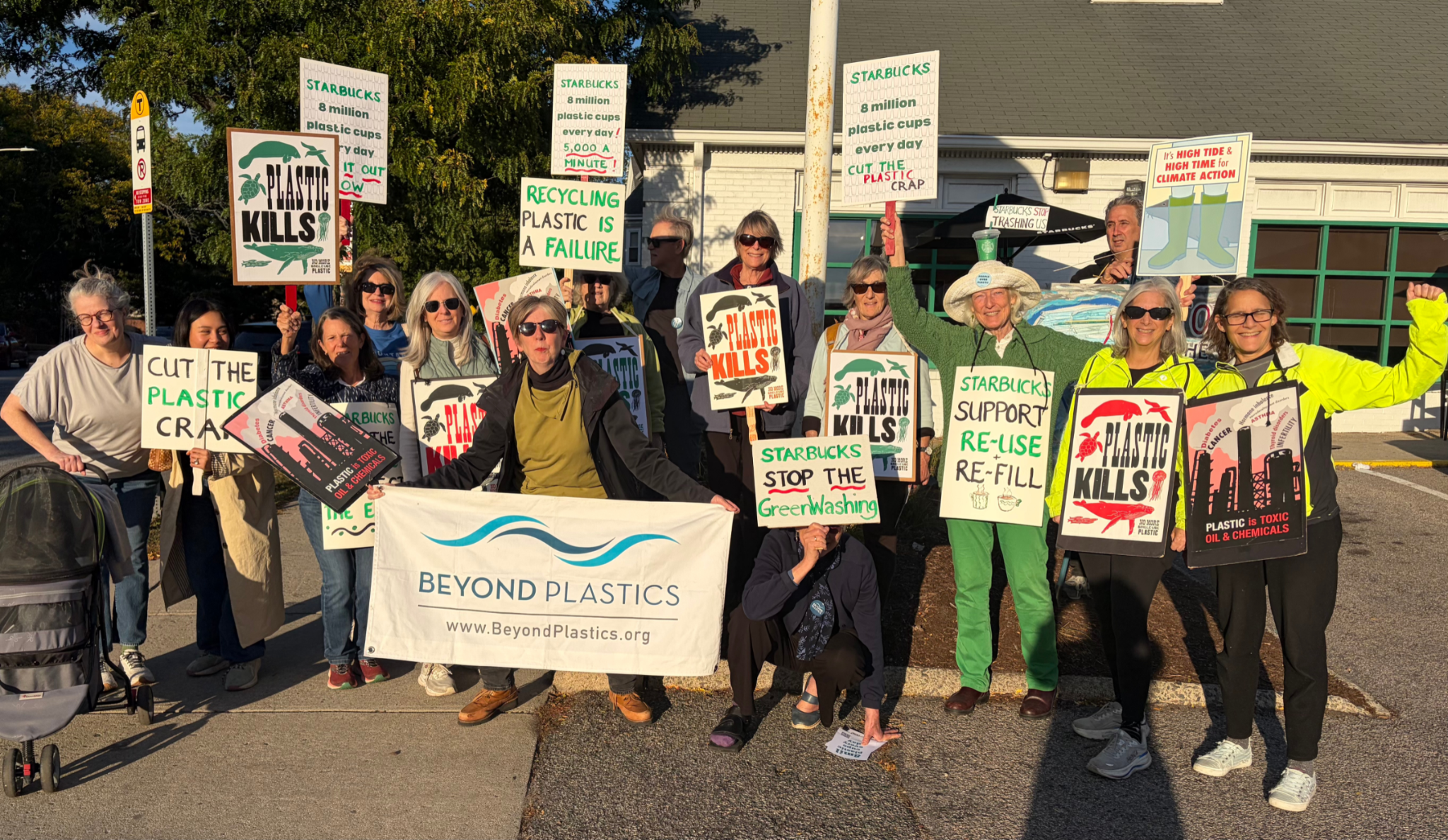
Advocates with Beyond Plastics Greater Boston kicked off the actions with a demonstration in Watertown, MA on Sept. 24
For example, Beyond Plastics Queens will hold their event three miles from where a cup tracker was placed in a Long Island City Starbucks-branded recycling bin. That cup last pinged at the Peekskill WIN Waste incinerator (formerly Wheelabrator), the largest source of air pollution in Westchester County, New York. There, advocates will hold an event with Westchester Alliance for Sustainable Solutions, a citizens’ group focused on legislative solutions to end waste incineration.
“Starbucks made $1.8 billion in profit in North America last year. How much of that was made from polluting our air, soil, and waterways with single use plastic? How much did that plastic pollution cost our communities in healthcare and waste disposal? I know that Starbucks cups are not recycled because I have toured the WIN-Waste trash incinerator in Peekskill, NY and seen the cups there myself! When that plastic is burned the polluted air is breathed by the people in my community, an environmental justice community. That pollution has been directly linked to the health problems Peekskill residents face—asthma, COPD, heart attacks,” said Courtney Williams, a cancer researcher who founded the Westchester Alliance for Sustainable Solutions.
At Starbucks headquarters in Seattle, Beyond Plastics Puget Sound is focused on five cups placed in Olympia Starbucks bins, just an hour from Starbucks headquarters. Two of those cups went to a landfill in Roosevelt, Washington, and three pinged from waste transfer stations – presumably on their way to disposal.
In Orange County, California, home of Starbucks CEO Brian Niccol, demonstrators will stand alongside representatives of the Starbucks Workers Union. Of the eight cups placed in Orange County Starbucks bins, six went to the Bee Canyon Landfill in Irvine, California. None of the stores surveyed in the county were serving customers in reusable mugs and glassware, even though reusable cups and mugs were displayed.
Meanwhile in Philadelphia, advocates are outraged that four cups placed in Starbucks-branded recycling bins went to the incinerator in Conshohocken, Pennsylvania. Environmental justice groups in the region have been mobilizing to pass the “Stop Trashing Our Air Act,” a local bill that would ban the city of Philadelphia from contracting with any company that incinerates its solid waste or recyclables. The advocates stress that when companies falsely portray their plastic as recyclable, it undermines momentum for real legislative solutions.
Demonstrators in Manhattan and Brooklyn will focus on cups that went from NYC to landfills in Pennsylvania and Ohio. Two additional cups traveled 1,000 miles each to a landfill in Alabama.
Reaction to Investigation and Week of Demonstrations
“Starbucks’ refusal to implement meaningful plastic reduction dooms communities, like those in Louisiana’s Cancer Alley, where we struggle with the harmful health and environmental impacts of the production of plastic,” said Jo Banner, cofounder and codirector of The Descendants Project, an organization of Black descendants of slavery that documents and fights environmental racism in Louisiana’s petrochemical corridor, where plastic for products like Starbucks cups is produced. “Communities need more than a coffee break — they need a break from toxic plastic production driven by companies like Starbucks.”
“Starbucks should take a fresh look at how it contributes to our single-use plastic problem,” said Jenn Engstrom, state director of CALPIRG Education Fund. “For the sake of our environment and our health, it's time for Starbucks to ditch its plastic lids and cups."
Starbucks Workers United, the employees’ union, issued the following statement: “We are proud to stand in solidarity with Beyond Plastics and CALPIRG in their efforts to hold Starbucks accountable for millions of plastic items in our communities every single day. As we have repeatedly shown, Starbucks continues to stray away from its values, including by repeatedly breaking labor law and refusing to settle a fair contract with over 12,000 union baristas who power the company every day. Starbucks says that one of their missions is to ‘do the right thing, even when it’s hard,’ so we are ready for Starbucks to honor that commitment and fully implement its reusable policy to serve all customers in our cafes in ceramic mugs and glasses, including the staffing needed to support it.”
LINK: View Beyond Plastics’ full investigation, tracking data and interactive map
All Events:
Watertown, MA, Sept. 24 - Beyond Plastics Greater Boston
Tempe, AZ, Sept. 28 - Plastic Free Phoenix
Philadelphia, PA, Sept. 29 - Echo Systems
Queens, NY, Sept. - Beyond Plastics Queens
Keene, NH, Sept. 29 - local environmentalists
Amherst, NH, Sept. 30 - Third Act Win-Win
Orange County, CA, Oct. 1 - Beyond Plastics, California Public Interest Research Group, Story of Stuff, Starbucks Workers United
Fort Collins, CO, Oct. 3 - Fort Collins Trash Mob
New Paltz, NY, Oct. 2 - Beyond Plastics New Paltz
Albany, NY, Oct. 3 - Beyond Plastics
Brooklyn, NY, Oct. 3 - Beyond Plastics Brooklyn
Buffalo, NY, Oct. 3 - Beyond Plastics Buffalo
Saugerties, NY, Oct. 3 - Citizens Concerned About Plastic Pollution
Westchester, NY, Oct. 3 - Beyond Plastics Lower Westchester
Seattle, WA, Oct. 3 - Beyond Plastics Puget Sound
Chicago, IL, Oct. 3 - Organizing for Plastic Alternatives
New York City, NY, Oct. 4 - Beyond Plastics, It’s Easy Being Green
Rochester, NY, Oct. 4 - Third Act Rochester
Burlington, VT, Oct. 2 - Vermont Public Interest Research Group
Houston, TX, Oct. 8 - Air Alliance Houston
Sacramento, CA, Oct. 8 - California State University Sacramento undergrad students, Starbucks Workers United
Pittsburgh, PA, Oct. 23 - Pittsburghers Against Single Use Plastics
About Beyond Plastics
Launched in 2019, Beyond Plastics pairs the wisdom and experience of environmental policy experts with the energy and creativity of grassroots advocates to build a vibrant and effective movement to end plastic pollution. Using deep policy and advocacy expertise, Beyond Plastics is building a well-informed, effective movement seeking to achieve the institutional, economic, and societal changes needed to save our planet and ourselves, from the negative health, climate, and environmental impacts for the production, usage, and disposal of plastics.
Contacts:
Dina Cappiello — dina@lifecyclecommunications.com, 202-415-5642
Judith Enck, Beyond Plastics — judithenck@bennington.edu, (518) 605-1770
###
