Report Projects New York Packaging Reduction Bill Will Save State Taxpayers $1.3 Billion in Just 10 Years
Less Trash Equals Big Savings for New York State if Legislature Passes Packaging Reduction and Recycling Infrastructure Act
For Immediate Release: April 16, 2025
Contacts:
Marissa Solomon — marissa@pythiapublic.com, (734) 330-0807
Judith Enck — judithenck@bennington.edu, (518) 605-1770
A new report from Beyond Plastics estimates that New Yorkers could save $1.3 billion over just one decade if the Packaging Reduction and Recycling Infrastructure Act (PRRIA) is adopted. The report — called "Projected Economic Benefits of the New York Packaging Reduction and Recycling Infrastructure Act" — outlines substantial cost savings, reduced packaging waste, and higher recycling rates from adoption of the bill into law.
This morning, Beyond Plastics and local elected officials held a news conference to discuss the report and its benefits to localities and taxpayers. A recording of the news conference will be uploaded to our YouTube channel later today.
To estimate savings, this analysis compared future collection and disposal costs with and without PRRIA’s required waste reduction, reuse, and recycling requirements. The report focuses on the savings — or avoided costs — of collecting packaging waste and taking it to landfills, incinerators, and recycling facilities under PRRIA, as compared to business as usual (no PRRIA). When quantities of packaging waste are lowered under PRRIA, collection and disposal costs are therefore also lowered: these are “avoided costs.” Our estimates find that the additional costs of recycling more waste would be outweighed by the savings from landfilling and incinerating less waste.
This report does not include the major new revenue source from packaging fees that will be given to local governments and private waste haulers to support waste disposal (because the fee structure hasn’t yet been established). When the new packaging fee revenue is considered, the economic benefits of this new policy will be significantly greater.
Among the report’s key findings:
New York state would save $1.3 billion during the first decade after PRRIA is enacted.
The $1.3 billion in savings over the first 10 years comprises $568 million for local governments, benefiting taxpayers, and $696 million for private waste hauler services — savings that would presumably be passed down to customers.
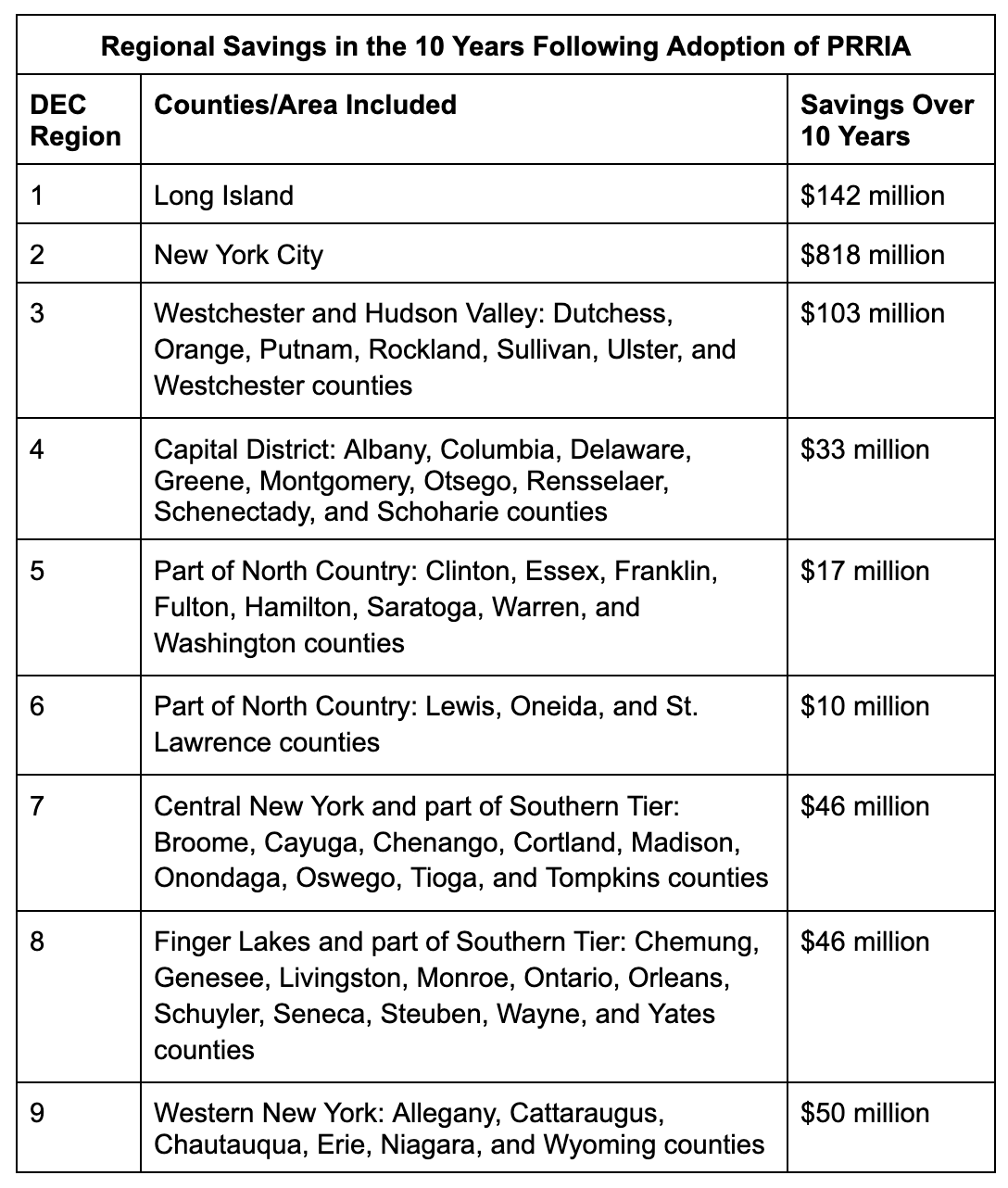
Two-thirds of the annual savings will accrue to New York City, which stands to save $818 million over the next 10 years.
Annual savings (i.e., avoided waste collection and disposal costs) in the years when PRRIA’s requirements go into effect are estimated to be:
$109 million in 2030, when the first recycling requirements go into effect
$287 million 2036, when the 20% waste reduction requirement goes into effect
$445 million 2040, when the 30% waste reduction requirement goes into effect
$830 million in 2052, when the 75% recycling rate requirement goes into effect
Packaging waste is projected to make up nearly a quarter of the municipal solid waste in New York state in 2025.
Almost 3.8 million tons of packaging waste will be generated in New York state in 2025 alone — a weight roughly equivalent to 10 Empire State Buildings.
Of the 1.5 million tons of PRRIA-covered packaging that New York City residents and businesses generate each year, our analysis estimates that 1.2 million tons are incinerated or landfilled.
All but one of New York state’s incinerators are located in environmental justice communities.
More waste recycled, less waste landfilled and incinerated via PRRIA:
When PRRIA’s required reuse and recycling rates are achieved, it is estimated that the proportion of packaging recycled (i.e., the recycling rate) will rise from the current 18% to 28% in 2035 and 44% in 2040.
When PRRIA is adopted, about half a million tons more recyclables will be sent to recycling facilities in 2040 than in 2025, and almost 2 million tons less garbage will be sent to landfills and incinerators.
“The staggering amount of single-use packaging waste is not only bad for the environment and public health, but it is also a huge waste of taxpayers’ dollars. It doesn’t have to be this way. New York state lawmakers have a comprehensive solution to this growing waste problem at their fingertips, and New Yorkers are depending on them to pass it. New York needs to make polluters — not taxpayers — pay by adopting this bill.” —Beyond Plastics president and former EPA regional administrator Judith Enck
“New York is in a solid waste crisis, which has clear negative environmental consequences and dire impacts on costs for residents and municipalities. This report shows the significant savings that the packaging reductions in the Packaging Reduction and Recycling Infrastructure Act will provide with less packaging material in the waste stream, particularly packaging that would be landfilled or incinerated, highlighting yet another reason why it is so essential to move this bill this session. We need to limit waste burdens on our environment and the cost of this trash on New Yorkers.” —Assemblymember Deborah Glick, chair of the Assembly Environmental Conservation Committee
“We knew that the Packaging Reduction and Recycling Infrastructure Act would save municipalities and taxpayers millions of dollars each year, but this new report quantifies the incredible financial impact of this necessary legislation. For the past 70 years, New Yorkers have paid the price for our plastic packaging waste removal and disposal — financially, environmentally, and from a public health perspective — and the status quo is no longer an option. More than a billion dollars in annual savings is available by enacting this bill. Thank you, Beyond Plastics, for this game-changing report — it is a real revelation that cannot be ignored.” —New York Senator and Senate Environmental Conservation chair Senator Pete Harckham
"This report shows that the Packaging Reduction and Recycling Infrastructure Act not only makes environmental sense but good economic sense, reducing the very real financial burden on our communities of disposing of mountains of packaging waste. For three years in a row now, the New York State Association of Counties has unanimously passed a resolution urging state lawmakers to pass this legislation, and our communities cannot afford any more delay. The PRRIA will save New Yorkers a projected $1.3 billion in avoided costs over the next decade, shift the costs of disposing of this waste from local governments and taxpayers to the corporations that generate it, and eliminate nearly 20 highly toxic and dangerous chemicals in plastic packaging that threaten public health and the environment. The time to move this legislation forward is now.” —Ulster County executive Jen Metzger, chair of the Climate Action, Energy, and Environment Committee of the NYS Association of Counties
“New York cannot afford to wait any longer to pass the Packaging Reduction and Recycling Infrastructure Act. Taxpayers and local governments are shouldering the burden of an outdated, unsustainable waste system — and this legislation is a common-sense solution. I’m proud to stand with leaders across the state to call on Albany to act. Let’s get this done.” —New York City Council member and Sanitation Committee chair Shaun Abreu
To view the full report, visit bit.ly/prria-report
About the Packaging Reduction and Recycling Infrastructure Act
Last year, the Packaging Reduction and Recycling Infrastructure Act passed the New York State Senate in June 2024 by a vote of 37-23, and passed four committees in the state Assembly. When the 2024 legislative session ended, a Siena Poll found that 58% to 31% of New York voters think the legislature should have passed the bill. The bill was popular across party lines, with 67% of Democrats, 44% of Republicans, and 54% of Independents agreeing it should have passed.
The Packaging Reduction and Recycling Infrastructure Act (S1464 Harckham/A1749 Glick) will transform the way our goods are packaged. It will dramatically reduce waste and ease the burden on taxpayers by making companies, not consumers, cover the cost of managing packaging. The bill will:
Reduce plastic packaging by 30% incrementally over 12 years (by 2040);
By 2052, all packaging — including plastic, glass, cardboard, paper, and metal — must meet a recycling rate of 75%;
Prohibit packaging’s worst toxic chemicals and materials, including PFAS, heavy metals like lead and mercury, PVC, polystyrene, and polycarbonate.
Prohibit harmful technologies known as chemical recycling to be considered real recycling;
Establish a modest fee on packaging paid by companies who sell packaged products, with fee revenue used to reimburse local governments (and therefore taxpayers) and private waste haulers for their costs in collecting and disposing of packaging waste.
Establish a new Office of Inspector General to ensure that companies fully comply with the new law.
Because the Packaging Reduction and Recycling Infrastructure Act would save tax dollars, over 30 localities across the state have passed resolutions urging Albany leaders to pass the bill. The New York City Council passed a resolution in support, and the City of New York released a memorandum of support in favor of the legislation.
More than 200 organizations and businesses — including Beyond Plastics, League of Women Voters, Physicians for Social Responsibility, Environmental Advocates, NYPIRG, Earthjustice, Blueland, and DeliverZero — have issued a memo of support stating, “This bill would save tax dollars and position New York as a global leader in reducing plastic pollution.”
Plastics and Climate
Plastic production is warming the planet four times faster than air travel, and it’s only going to get worse with plastic production expected to double in the next 20 years. Plastic is made from fossil fuels and contains up to 16,000 chemicals, many of them known to be harmful to humans and even more untested for their safety. Most plastics are made out of ethane, a byproduct of fracking. In 2020, plastic’s climate impacts amounted to the equivalent of nearly 49 million cars on the road, according to a conservative estimate by Material Research L3C. And that’s not including the carbon footprint associated with disposing of plastic.
Plastics and Health
Less than 6% of plastic in the United States actually gets recycled, and only 9% of all the plastic waste ever generated, globally, has been recycled. The rest ends up burned at incinerators, buried in landfills, or polluting rivers and the ocean — an estimated 33 billion pounds of plastic enter the ocean every year.
Microplastics are entering our soil, food, water, and air. They have been found in human placenta, breast milk, stool, blood, lungs, and brain. Scientific research continues to find that the microplastics problem is worse than previously thought: New research in the New England Journal of Medicine shows that microplastics are linked to increased heart attacks, strokes and premature deaths. Another new study from Columbia University found that bottled water can contain hundreds of thousands of plastic fragments.
Why Chemical Recycling Isn’t a Solution
Because plastics recycling is a failure, the plastics and petrochemical industries are now pushing a pseudo-solution: chemical recycling, or “advanced recycling.” This is a polluting process that uses high heat or chemicals to turn plastic waste into fossil fuels or feedstocks to produce new plastic products. It’s a dangerous distraction that’s allowing companies to exponentially increase the amount of plastic — and greenhouse gases — they put into the world. Learn more from Beyond Plastics’ report, “Chemical Recycling: A Dangerous Deception.” These New York bills do not ban chemical recycling but simply do not allow chemical recycling to count toward the recycling rate requirements.
About Beyond Plastics
Launched in 2019, Beyond Plastics is a nationwide project that pairs the wisdom and experience of environmental policy experts with the energy and creativity of grassroots advocates to build a vibrant and effective movement to end plastic pollution. Using deep policy and advocacy expertise, Beyond Plastics is building a well-informed, effective movement seeking to achieve the institutional, economic, and societal changes needed to save our planet and ourselves, from the negative health, climate, and environmental impacts for the production, usage, and disposal of plastics.
###
