A Conversation: Karenna Gore of the Center for Earth Ethics and Judith Enck of Beyond Plastics
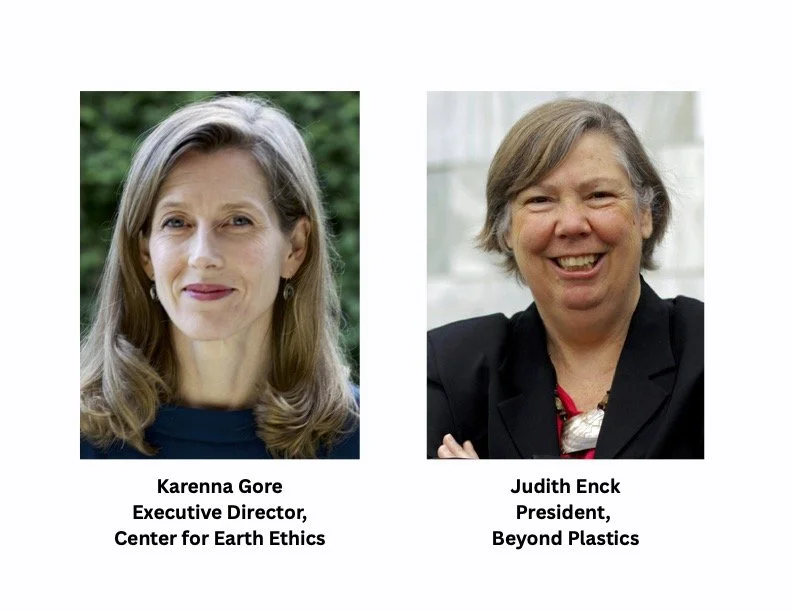
JUDITH: Karenna, you are the founder and executive director of Center for Earth Ethics at Union Theological Seminary in New York City. Your statement of purpose states that the Center “works to change the dominant value system from one based on short-term material gain -- no matter the pollution, depletion and inequity that result -- to one based on the long-term health of the whole community of life.” At Beyond Plastics, we are also seeking a long-term goal of institutional, economic, and societal change. We both speak of change. How do you envision that change happening and who -- whether a person or a group -- do you see leading that change?
KARENNA: At Center for Earth Ethics our focus is on value systems. How do we understand our relationships and our responsibilities to the rest of the natural world? What are the worldviews or ways of seeing that have led us into the extreme ecological crises we are now living within? Who among us suffers the most from this - how can we acknowledge and assist them? Why is it important? We keep these types of existential questions in mind because we believe they have the necessary power for a meaningful shift to happen. A change in behavior requires a change in consciousness.
There is no one person who can do this alone, and it also takes more than one group or approach. We seek to understand, respect and uplift the work that is happening in all kinds of different ways – policy advocacy, research, ecological restoration, community organizing, and even spiritual practices, individual and community. There are many ways to make change, and they all overlap and inform each other. The kind of collective decision making we need happens in laws and policies. And policy changes, even small ones or ones that seem fleeting, have ripple effects on our thinking in a good way.
That said, if we want our policy changes to have any foundation and capacity to last, we need to build and fortify a foundation of cultural values and social norms. We have seen how powerful profit-driven interests can harness political processes and quickly roll back progress. So we want to cultivate a positive feedback loop with all the different forms of changemaking inspiring all the others.
That’s exciting because it means there is not just one way. It means everyone gets to contribute according to their gifts and passions and experiences and perspectives. We need people drafting workable economic policies that phase out fossil fuels and we also need people convening conversations about what the right relationship with creation means. These are all related.
And if change comes in infinite ways it also means that the “leaders” are a vast array - countless individuals, groups and communities. Finally, we know that we can be led not just by other humans but by the land itself – by the intelligence and teachings of the land which can guide us.
JUDITH: You’ve been doing this work for many years, with a focus on spirituality and faith. What part do you think spirituality plays in creating change and does it serve to reach different audiences? And what are some specific things that the faith community is doing to address pollution of our planet?
KARENNA: Spirituality brings us into the realm of deeper questions about how we understand the nature and meaning of life. This includes our relationship to ourselves, other human beings, and also to all other life – to the plants, other animals, to the land, to water and fire and air.
Different spiritual traditions have different teachings and ways of understanding these questions. The sacred texts and stories and teachings of all traditions have within them resources for responding to the ecological crises we are facing. They also serve as a place of spiritual sustenance to help us face these crises honestly. Some traditions, like so many Indigenous spiritual traditions, have a different framework for understanding notions of relationship than so many Western norms and assumptions. They have retained, in many cases, a strong spiritual understanding of the sacredness and aliveness of the land, and of the interconnection of all life. We have much to learn from these spiritual traditions. And then we can also go deeper into world religions like Christianity (which is what Union Theological Seminary was founded in) and find portals there too.
What are faith communities doing to address pollution? So many different things. They are exploring their sacred texts and teachings to help find ethical guidance and inspiration to share with their communities. Some do active advocacy and movement building,as you can see in the work of Creation Justice Ministries. Some faith leaders are issuing bold statements and mandates like Pope Francis’ Laudato Si’ or the Islamic Al-Mizan covenant. Some faith communities are working to reduce fossil fuel dependence within their own meeting places. They are planting gardens and planting trees. Some, like the Church of the Wild Network, are taking their congregations outdoors to nourish the love between people and land. They are lobbying lawmakers for policy change. They are holding ceremonies and providing spiritual guidance and care. It’s exciting to pay attention and learn from what faith communities are doing on all levels.
In so many ways, faith and spiritual communities are the perfect place for this work to be happening because these are gathering places where the deeper conversations about values and ethics have always happened. And these explorations of values and ethics, we think, are a crucial element of addressing our ecological crises.
As you know, religious communities are also specifically addressing plastic pollution. Churches, Synagogues, Mosques, Buddhist monasteries are working to ban single use plastics in their communities. Creation Justice Ministries put together a resource guide called “Plastic Jesus: Real Faith in a Synthetic World” to help congregations think about and discuss plastic pollution. The Church of England asked people to give up plastic for Lent. And of course, Beyond Plastics created a toolkit for faith communities with ideas of tangible ways to address the issue.
JUDITH: As at Beyond Plastics, the Center for Earth Ethics has as a priority area of focus Environmental and Climate Justice. How can we best ensure that the voices of frontline communities -- as well as those of Indigenous communities, another priority area of the Center -- are heard and included in the conversation?
KARENNA: We can use our skills, and whatever political, economic, or social privileges or relationships we have to make sure that frontline communities are included in important conversations. We can make sure invitations are made and relationships are formed and travel costs are paid for to bring people into spaces together.
Importantly, we have the responsibility to not only “hear and include” but to follow the leadership of frontline communities – who in many cases have the experience, the perspective, and sometimes the ancestral knowledge to better understand the situation or to propose different ways of doing things.
And we also have the responsibility to educate ourselves. The experiences of frontline communities have historically been invisibilized - in part intentionally. Corporate money is poured into keeping us from thinking about the fallout of our extremely consumeristic society. Because the fallout – the health and ecological burdens that are placed first and foremost on frontline communities – is built into the system of the industries. The health and wellbeing of frontline communities are the “hidden costs,” the “collateral damage” of a culture that allows, encourages really, people to overconsume – to buy more stuff, to use more energy. And a refusal to allow these hidden costs to remain invisible is a responsibility and a crucial part of giving people the understanding they need to motivate and demand change.
JUDITH: Both of our organizations advocate for policy change and work on creating awareness about the threat of plastics to human health and the planet. What would you say is the biggest threat we're facing from plastics today?
KARENNA: The threat from plastics is multidimensional and terribly widespread, I’m not sure we can point to one aspect that is the biggest threat. Essentially the threat is to the health and wellbeing of all life on the planet. Microplastics, and therefore also the hundreds of toxic chemicals that are in plastics, are now found all throughout our bodies – our bloodstreams, our organs, our brains. They are a regular part of our drinking water and the food that we eat. And more and more research is coming out about the vast array of human health risks – cardiovascular risk, cancer, dementia, depression, and on and on. And of course this damage is being inflicted on all other animals as well, causing illness for individuals and threatening the health of species and the balance of ecosystems.
The health crisis is beginning to receive a little more attention – thanks in large part to the remarkable and steadfast work of organizations like Beyond Plastics. But considering how vast, profound, and scary the implications are, it’s very disturbing how little attention it has received so far. Not surprising maybe, given the economic and political power of the plastics industry and their lobbying, but still incredibly disturbing. Likely, at this point, many people also do not want to look too deeply at how scary it really is because it’s quite overwhelming.
One aspect that has been even slower to come into widespread public understanding is the extreme damage that the plastic related industries are inflicting on the communities in which they are operating and continuing to build their factories and facilities – primarily low income communities and communities of color. I had the opportunity to visit St. James Parish in Louisiana to learn firsthand from the community there about that, and I could smell the air pollution from the petrochemical factories while just standing right outside their homes. We know that these communities are suffering cancer rates much higher than the national average. Parents are having to raise their kids in these areas knowing (or sometimes not knowing) what their children are being exposed to and not being able to do much about it. It is an act of violence– what has been called “slow violence” for a company to knowingly put people in that position.
Many people also don’t realize that plastic pollution is ubiquitous even in supposedly more “sustainable” industries. As my colleague Tory Field (Research & Ethics Manager, Center for Earth Ethics) has taught me, large scale organic agriculture relies heavily on plastic. Many large scale organic farms literally cover the soil with single use black plastic to control weeds and raise soil temperatures, and cover fields of plants with plastic sheets to reduce pest pressure. This creates an enormous amount of plastic pollution and also fills the soil with microplastics. We don’t want to place the blame on organic farmers, because in many cases they are just trying to do better within the confines of trying to compete within a larger food industry that promotes industrial and chemical agriculture. But it goes to show how pervasive it is.
JUDITH: Earlier this month, we were together to discuss many topics, including Beyond Plastics’ book, The Problem with Plastic. We include a chapter in the book about the people we admire, who inspire us with their advocacy work, and their commitment to this issue. Who has inspired you in your work?
KARENNA: I am inspired by public health pioneer Alice Hamilton who worked in the early twentieth century to demand that we acknowledge and regulate the harmful industrial chemicals that were poisoning workers. Rachel Carson worked in a similar way to stop toxic chemicals and was prophetic in how she helped us understand the interconnectedness of ecosystems. Her work calls us to a sense of wonder and beauty, as well determination, resistance and wise regulations. Dolores Huerta also did phenomenal work– and is still going! She organized farmworkers, fought pesticides, and is a voice for those immigrant laborers who provide so much important work with our food and are also so often vulnerable to abuse. And finally, I love the women who worked on racial justice and liberation, like Ida B. Wells who exposed and fought lynching and worked for women’s suffrage, and Septima Clark who helped train people to overcome voting restrictions and dismantle segregation and work for good equitable education.
JUDITH: Thank you so much, Karenna. What a pleasure speaking with you at Center for Earth Ethics earlier this month and again today. We are deeply honored to partner with you and your organization to stem the tide of plastic pollution.