

Single-Use Vapes Are a New Major Source of Plastic Pollution
What Are E-Cigarettes and Vaping Products?
Electronic cigarettes (e-cigarettes) and vaping products are electronic devices typically composed of a lithium-ion battery, internal metals, and chemical liquids. Most are sold as sealed, single-use plastic cartridges designed to be discarded once the liquid or battery runs out. However, there are reusable/refillable vaping devices.
Nicotine Vapes: Often contain high concentrations of liquid nicotine mixed with propylene glycol, glycerol, and, in some products, flavoring chemicals to appeal to young people.
Cannabis Vapes: These do not contain liquid nicotine, but instead use concentrated cannabis extracts or terpene blends. Cannabis vapes deliver the highest levels of THC across cannabis products.
Explosive Growth of Plastic Pollution from the Vapes
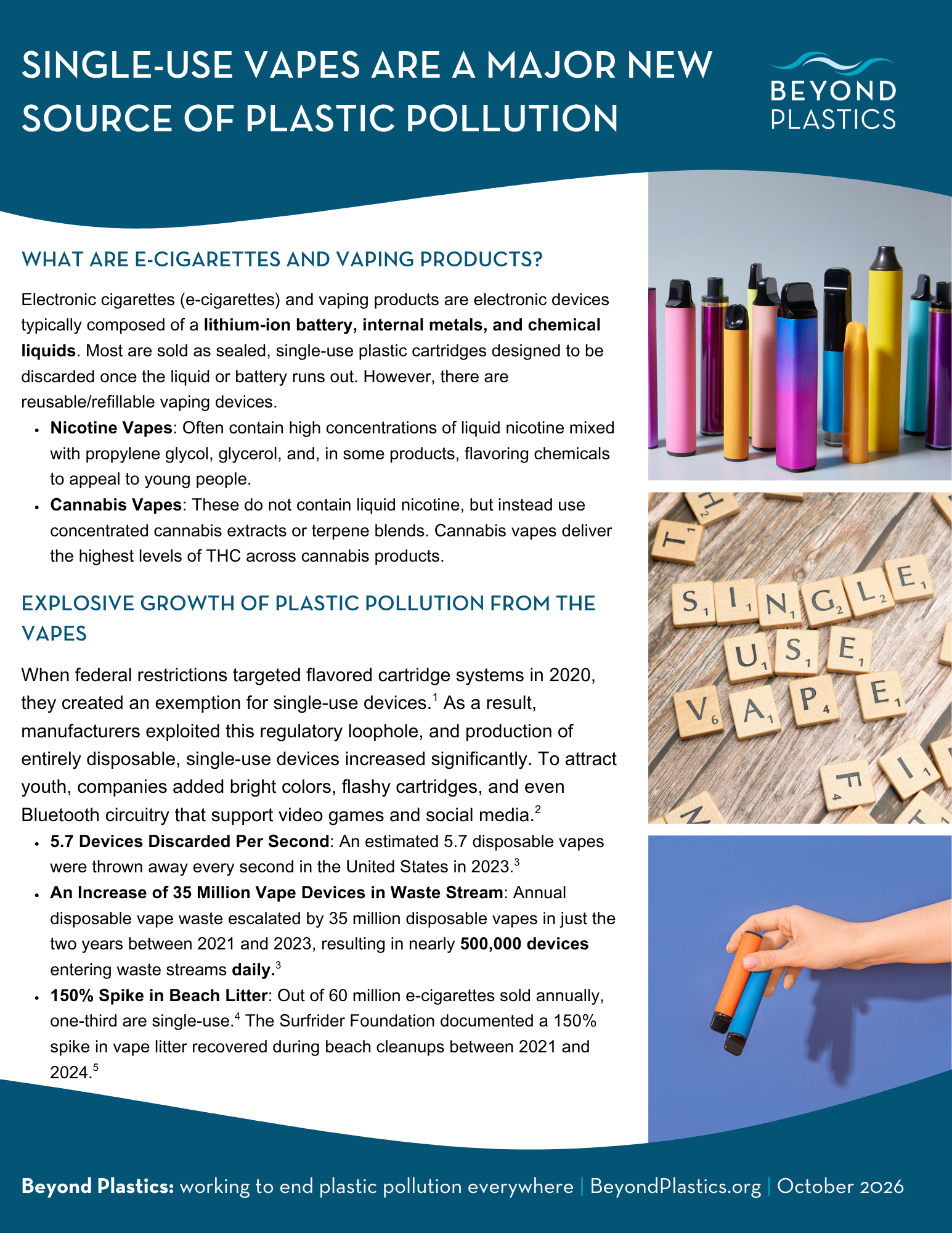
When federal restrictions targeted flavored cartridge systems in 2020, this created an exemption for single-use devices.1 As a result, manufacturers exploited this regulatory loophole, and production of entirely disposable, single-use devices increased significantly. To attract youth, companies added bright colors, flashy cartridges, and even Bluetooth circuitry that support video games and social media.2
5.7 Devices Discarded Per Second: An estimated 5.7 disposable vapes were thrown away every second in the United States in 2023.3
An Increase of 35 Million Vape Devices in Waste Stream: Annual disposable vape waste escalated by 35 million disposable vapes in just the two years between 2021 and 2023, resulting in nearly 500,000 devices entering waste streams daily.3
150% Spike in Beach Litter: Out of 60 million e-cigarettes sold annually, one-third are single-use.4 The Surfrider Foundation documented a 150% spike in vape litter recovered during beach cleanups between 2021 and 2024.5
Single-Use Vapes are a Toxic Triple Threat
Discarded e-cigarettes represent a complex, fast-growing plastic pollution problem. They combine single-use plastics, hazardous chemical waste, and electronic waste into one problematic device. Data shows a severe lack of public awareness about safe disposal: a Truth Initiative survey found that 51% of users aged 15–24 throw devices straight into standard trash cans, 17% put them in household recycling, and only 15% use electronic recycling facilities.6
Unrecyclable Plastic: Devices are permanently sealed shut to keep internal circuitry and toxic liquids inside. A consumer, and even many recycling facilities, cannot safely separate devices for proper disposal and recycling.
Acute Hazardous Chemicals: The U.S. EPA classifies unused liquid nicotine as acute hazardous waste.7 Discarded e-cigarettes may leak lead, nickel, chromium, volatile organic compounds, and microplastics into the environment. They contain hazardous chemicals like acetaldehyde, formaldehyde, benzene, and acrolein.8 The smell of flavored nicotine vape liquid fragrances is appealing to animals, but both nicotine and THC concentrates are highly toxic to pets and wildlife.9
Landfill Fire Hazards: Lithium-ion batteries in garbage trucks or municipal shredders can catch fire when crushed, which can trigger a dangerous chain reaction if a battery overheats.10 The internal heat melts the safety barrier that keeps the battery's positive and negative sides apart. Once they touch, they react violently, causing the temperature to increase and ignite the liquid inside, which can lead to a fire or explosion
RECYCLING HURDLES & POLICY SOLUTIONS
The Downstream Recycling Bottleneck
Managing vape waste is exceptionally difficult and costly. Consumers have few recycling options because standard electronics recyclers cannot legally accept these devices due to the contained nicotine, and hazardous waste vendors reject sealed e-cigarettes because of transport and recycling difficulties.11 Additionally, once a consumer purchases a vape product and then discards it in their trash, the waste is then classified as household waste, and the consumer has no legal obligation to dispose of it correctly. Household trash is legally exempt from commercial hazardous waste regulations.12
School districts face significant costs to properly dispose of confiscated student vapes. Disposal services often charge hundreds of dollars per pound to process them safely.13
These devices pose:
Shredding Fire Risks: Intact vapes cannot pass through standard electronic waste shredders because crushing the sealed lithium battery may trigger facility fires.
Strict Battery Processing: Depending on where you live, vapes are treated as Household Hazardous Waste (HHW).12 Local laws vary because authorities are trying to safely manage the double threat of lithium batteries and liquid nicotine.14 Intact vapes must first go through specialized intermediate hazardous waste handlers to extract the cells. New York, for instance, has several registered E-Recyclers, but most do not accept vape waste.15
The Cannabis Legal Hurdle: Residual THC remains a federally controlled substance,16 so standard interstate battery recycling lines and transporters cannot touch them. Cannabis vapes must instead be isolated and processed locally by state-licensed hazardous waste operators directly within legal dispensaries.13
What People Can Do
Individual Action
Avoid Disposables Entirely: Not ideal from a health standpoint, but users could switch from single-use devices to refillable, rechargeable pod, or open-tank systems to slow electronic waste production.
Dispose of These Devices as Hazardous E-Waste: Never discard vapes in household trash or residential recycling bins. Secure spent devices in a resealable plastic bag, tape loose battery ends, and deliver them to designated municipal hazardous waste locations.17
What Can Policy Makers and Regulators Do?
More importantly, new laws are needed that prohibit the sale of single-use vaping devices. We do not support Extended Producer Responsibility legislation for vaping devices because those policies will not solve this growing problem.
The UK banned the sale and supply of all single-use disposable vapes across online and physical stores in 2025.18 This nationwide ban applies to all businesses and organizations to cut down on youth vaping and reduce plastic waste.
The state of California adopted a law in August 2026, AB 762, which prohibits the import, manufacture, and sale of single-use, battery-embedded disposable vapes to address fire hazards and electronic waste.19 “We don’t let other industries design products with embedded fire hazards and walk away when they fail. Vape companies shouldn’t get a pass either,” said Tony Hackett, a policy associate at Californians Against Waste. “AB 762 is simple: if you’re going to sell it in California, you have to design it so it doesn’t explode in someone’s hands—or in a recycling truck.”20
The New York State Tobacco Product Waste Reduction Act: NY State legislators have introduced bills S2223 and A6444 to explicitly ban the sale of single-use electronic cigarettes and single-use cigarette filters statewide.21 The bills have not become law.
Nicotine Restrictions: New York has enacted several policies to curb vaping, including a ban on flavored nicotine, a 20% tax on e-cigarettes, public smoking bans, and stricter penalties for retailer violations.22 Flavored bans have led to a 74% reduction in vape sales in Massachusetts and a 52% drop in California.3
Colleges and universities are increasingly adopting tobacco-free campus policies that completely ban all tobacco products.23 Expanding the tobacco bans to cover vaping devices will help keep these hazardous materials out of the waste stream.
Legislation should consider a large mandatory deposit on cannabis vaping devices, similar to state-level container deposit laws, known as bottle bills. A hefty refundable deposit would require every business that sells vaping devices to accept the returns and refund the deposit, and require the manufacturers to figure out how these products can be safely disposed of - something they should have done before selling them.
REFERENCES
1. FDA Finalizes Policy on Flavored Vape Products — Chicago Medical Society. https://www.cmsdocs.org/news/fda-finalizes-policy-on-flavored-vape-products.
2. Loukas, A. et al. Electronic Nicotine Delivery Systems Marketing and Initiation Among Youth and Young Adults. Pediatrics 144, e20183601 (2019).
3. Lucas Rockett Gutterman. Vape Waste 2: The Environmental, Financial, and Security Cases for Banning Disposable Vapes. https://pirg.org/edfund/resources/vape-waste-the-environmental-harms-of-disposable-vapes/ (2025).
4. Beutel, M. W. et al. A Review of Environmental Pollution from the Use and Disposal of Cigarettes and Electronic Cigarettes: Contaminants, Sources, and Impacts. Sustainability 13, 12994 (2021).
5. Beach Cleanups. Surfrider Foundation https://cleanups.surfrider.org/results/.
6. A Toxic, Plastic Problem: E-Cigarette Waste and the Environment. https://truthinitiative.org/research-resources/harmful-effects-tobacco/toxic-plastic-problem-e-cigarette-waste-and-environment (2021).
7. US EPA, O. How to Safely Dispose of E-Cigarettes: Information for Schools and Small Businesses. https://www.epa.gov/hw/how-safely-dispose-e-cigarettes-information-schools-and-small-businesses (2024).
8. What’s in an E-Cigarette? https://www.lung.org/quit-smoking/e-cigarettes-vaping/whats-in-an-e-cigarette.
9. Adrienne Duke & Tera Glenn. Vaping: The Latest Environmental Problem. Alabama Cooperative Extension System https://www.aces.edu/blog/topics/home/vaping-the-latest-environmental-problem/ (2023).
10. Lithium-Ion Battery Safety. Columbia Research https://research.columbia.edu/lithium-ion-battery-safety.
11. Vapes Don’t Belong in Your Household Trash. https://www.des.nh.gov/news-and-media/blog/september-2025-vapes-dont-belong-your-household-trash (2025).
12. US EPA, O. How to Safely Dispose of E-Cigarettes: Information for Schools and Small Businesses. https://www.epa.gov/hw/how-safely-dispose-e-cigarettes-information-schools-and-small-businesses (2024).
13. Vape Waste Collection Pilot Program. https://www.centerforsmm.org/vape-waste-collection-pilot-program.
14. Ellen Abbott. New York Launches Vape Recycling Pilot Program To Address Growing Issue of Vape Waste. New York NOW from whmt https://nynow.wmht.org/blogs/politics/new-york-launches-vape-recycling-pilot-program-to-address-growing-issue-of-vape-waste/ (2025).
15. Registered Electronic Waste Recycling Facilities. https://dec.ny.gov/environmental-protection/recycling-composting/electronic-waste-recycling/registered-facilities.
16. Lampe, Joanna R., Sacco, Lisa N., & Sheikh, Hassan Z. The Federal Status of Marijuana and the Policy Gap with States. https://www.congress.gov/crs-product/IF12270 (2026).
17. National Disaster Debris Recovery Facilities (EPA 2026).
18. Single-use vapes ban: information for businesses. https://www.gov.uk/guidance/single-use-vapes-ban (2025).
19. Jacqui Irwin. Disposable, Battery-Embedded Vapor Inhalation Device: Prohibition and Penalties. (2026).
20. STATEMENT: CA legislature approves ban on disposable vapes. CALPIRG https://pirg.org/california/media-center/statement-ca-legislature-approves-ban-on-disposable-vapes/ (2026).
21. Liz Krueger & Cordell Cleare. NY State Senate Bill S2223.
22. New York State Tobacco Control Laws. https://www.health.ny.gov/prevention/tobacco_control/current_policies.htm (2024).
23. Wong, S. L. et al. A Multimodal Assessment of Tobacco Use on a University Campus and Support for Adopting a Comprehensive Tobacco-Free Policy. Prev. Med. 133, 106008 (2020).
