Pollution Is Colonialism
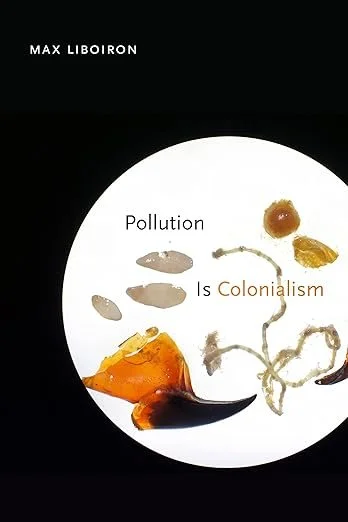
Released in May 2021 from Duke University Press | 216 pages.
By Max Liboiron
Recommended by Sam in Wilmington, NC:
“Pollution is Colonialism completely shifted how I think about environmental harm—not just as a scientific issue, but as a political and colonial one. It made me question who gets to define what counts as pollution, and why. Liboiron’s work is powerful, grounded, and accessible, and it’s inspired me to think more critically about the ethics behind research, activism, and even recycling.”
From the Publisher:
In Pollution Is Colonialism Max Liboiron presents a framework for understanding scientific research methods as practices that can align with or against colonialism. They point out that even when researchers are working toward benevolent goals, environmental science and activism are often premised on a colonial worldview and access to land. Focusing on plastic pollution, the book models an anticolonial scientific practice aligned with Indigenous, particularly Métis, concepts of land, ethics, and relations. Liboiron draws on their work in the Civic Laboratory for Environmental Action Research (CLEAR)—an anticolonial science laboratory in Newfoundland, Canada—to illuminate how pollution is not a symptom of capitalism but a violent enactment of colonial land relations that claim access to Indigenous land. Liboiron's creative, lively, and passionate text refuses theories of pollution that make Indigenous land available for settler and colonial goals. In this way, their methodology demonstrates that anticolonial science is not only possible but is currently being practiced in ways that enact more ethical modes of being in the world.
